|
 |
 |
|
|
Great Hunting in North America
|
|
*This article has not been edited*
This is my experience of a “great” hunt which nearly ended in “great” tragedy followed by another “great” hunt and finally ending with a “super” hunt culminating one of the best hunting seasons of my life—all right here in North America.
September 2008 found me and my son David W. leaving home, Spencer, WV, for British Columbia to hunt with Tuchodi Outfitters run by our friends Larry and Lori Warren. In four years this would make our third hunt with them, all of which have been great, successful hunts. In several hunts over the past twenty years, Tuchodi Outfitters is only one of the two outfitters that we have returned to for repeat hunts. This hunt required a fly-in by bush plane to a remote camp approximately 100 miles from Fort Nelson. Off to a great start the first day, my son, using a Bad Bull Muzzleloader, bagged a moose at 350 yards. Day two saw him and his guide set out for a hunt deeper into the wilderness about 50 miles on horseback, and after a day and half the night in rain |
 |
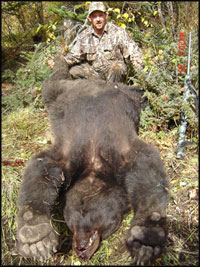
| and snow, they reached their destination and set up spike camp. The next day, David W. bagged a great grizzly that will make the record book. The Bad Bull Muzzleloader proved it’s worth the next day with David W. bringing down a 6x6 elk. The following day saw him taking a mountain billy goat at 720 yards. Retrieving the goat the next day, they broke camp and toting meat, cape and horns returned to our camp. |
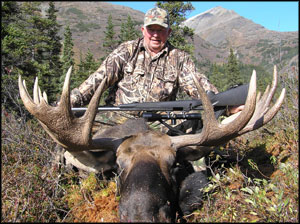
Our original plans were to spend the first week at this camp hunting moose and grizzly and upon David W.’s return, fly to base camp to hunt the second week for elk and goat. My hunt was going along fine. With my Bad Bull Muzzleloader I had bagged a great moose on the fourth day. Day five, another hit this time bringing down a silver tip grizzly. Day six, tragedy struck while on horseback hunting mountain goat. We had spotted a goat but decided that with my being sixty-two years old in addition to being overweight and without much daylight hours remaining, we should begin our four-hour ride to return to camp. The ride back to camp was uneventful. As I was dismounting the horse, half on and half off, he spooked. There I was, just like televised rodeos, trying to get back into the saddle of a bucking bronco. In the saddle for a few seconds, he bucked again, tossing me high into the air. Landing on my right side and feeling the bones in my pelvis and hips crunching together, I soon realized my injuries were severe.
|
 |
My guide, the camp cook, another guide and hunter quickly fashioned a stretcher from an old log pole ladder, rolled me onto it and carried me into the cook’s cabin. As I was in excruciating pain, my guide set out to meet my son with his guide to call for help on their satellite phone. Using my Global Star Satellite phone, the camp cook repeatedly tried to call out only to be disconnected after five seconds at a time. Returning to camp that night David W. learned that our dream hunt had turned into a real nightmare
As darkness settled in, using the two phones, contact was made with Larry Warren at base camp. With weather worsening, a night flight was out of the question. Turning black and blue from my knee to my shoulder and not knowing if my internal organs were injured, I spent the longest night of my life just waiting. Day light brought worsened weather. High winds kept the Medi-Vac Helicopter from crossing the pass. The winds also caused
|
| Larry and the same pilot who had brought us in to turn back. The guides and my son were racking their brains to find a way to get me out of the camp. With my injury, horseback was not an option. My only hope was for airlift out of this remote camp. |
As luck would have it, about three o’clock that afternoon we heard a chopper. It had flown around the mountain stopping at another camp for fuel and was stopping to refuel again at our camp. In British Columbia fuel is stored at camps just for events such as ours. They placed me on a back board and into the chopper for transport to Fort Nelson. X-rays revealed a suspected broken back before my next stop to Prince George. There I was told my back was not broken. Finally on the evening of the fourth day after the accident, I was on my way home on a private Med-Jet, which, by the way, is one expensive flight.
The following day, arriving in Charleston, WV, the doctor determined that major surgery would be required to repair my pelvis and the fracture in the back region of the pelvis would have to heal by itself. |
 |
| Within only two hours after a four hour surgery which involved bolting my pelvis together with a steel plate and six bolts, I felt good and knew for the first time that I was going to be okay. After a short recovery period I was released October 6th on my 62nd birthday. |
The next six weeks was pretty much a recovery period. Then, against my good doctor’s advice, as well as my wife and friends, my son and I were off to Alberta, Canada on a mule and whitetail hunt. We had booked this hunt the previous year while on a mountain hunt for mule deer. We conferred with the outfitter Blue Bronna about my injuries and mobility. We explained that we hunted with custom gun and scopes set up by the Best of the West (shooting beyond belief) and that we were capable of killing deer at extreme ranges. We were assured that if we still wanted to hunt they would accommodate our needs. On the fourth day of this hunt my guide and I sat on a bluff, glassing a river canyon. We spotted a beautiful mule buck. One thing I was learning was that to complete my long range shots when not on level ground like in Kansas, I need a long range finder that is for steep angles and true distance. Using my Swarovski Range Finder, we ranged the deer at 900 yards. After discussing the true range with my guide, I set the compensator for 900 yards. If I would miss, the bullet would hit high over the deer and probably not spook it. With his spotting scope the guide could determine how high I was hitting. On the first shot nothing happened nor indicated how high. On the second shot, his spotting scope told us that I was thirty inches high from where I was holding. The deer had turned a little bit and was standing with his head above his shoulders. I told the guide that I would hold on the lower shoulder and should hit him in the neck. The third round was squeezed off and in what seemed like three seconds, the guide started yelling “You smoked him! You smoked him”! The deer had dropped in his tracks. As I was not able to retrieve my trophy, I sat on the bluff and the guide inched his way over the rough canyon to the deer. The bullet had hit the deer right in the back of the neck at the base of the head and the bullet was recovered just under the skin between its eyes. Some might say it was luck, but with the right equipment and practice shooting, shots like this can be made. It is not for everyone to try. You have to be dedicated and practice. Just before the trip shooting from my wheelchair at 600 yards, I shot a three shot group that measured on and three quarters inches. (see enclosed target) On the fifth day of this hunt I took a 165 inch 13 point whitetail at about 200 yards. That same day, my son took a super 5x7 at 655 yards.
The next trip was to Illinois on a whitetail muzzleloader hunt. On the first day of the hunt my son killed a nice eight point from a ladder stand. On the third day he hunted with me to spot and drive deer. He spotted a twelve point that I just could not get on. We relocated and still were unable to obtain a shot. Finally, after relocating for the third time it all came together for a clean one shot kill with my Bad Bull Muzzleloader. The twelve point was down for the count. |
 |
The final hunt of 2008 was a Kansas whitetail hunt. We went on this hunt four days earlier to close the deal on a 240 acre farm. We closed on the land two days before gun season started and that same day set up a scent-tight box blind on 16 foot 4x4 timbers. The land is rolling a little and at this height looking over the CRP gave me a great advantage. On Wednesday morning, the first day of gun season, I was in the blind thirty minutes before daylight. It wasn’t looking too good. We had forty mile per hour north winds, but a good thing did happen about 9:30 a.m. Directly downwind came a deer running toward the CRP to the land we had just purchased. I had my compensator set on 300 yards. The deer was closer to 400 yards but running. As it slowed down and paused, I shot. It looked like it jumped ten feet into the air. I had made a solid hit, but was just a little low. The deer ran across the CRP out |
of my sight. By that time he was within my son’s sight. He could see from the blood on the front shoulder that the deer was crippled. He got off three shots, but was shooting cross wind and could not close the deal. As luck would have it, the deer headed back into my direction. When he was within sight and in range I finally got my 196 inch gross “Booner” on the ground for good. Later in the week David W. downed a really nice nine point at 550 yards.
In closing, during the sixteen day hunt that started in British Columbia, which actually became a seven day hunt, we harvested two grizzly, two bull moose, one mountain billy goat, one bull elk. The Alberta six day hunt yielded two mule bucks and two whitetail bucks. The Illinois three day muzzleloader hunt ended with two whitetail bucks. On the Kansas hunt, three whitetails were taken. There, our friend Rick Prine got a nice buck and mine is sure to make the Boone and Crockett Record Book. In our home state of West Virginia, son David W. captured a 130 inch eight point early in bow season while I was recovering from my surgery.
Several of the animals were taken at extreme range. We have the best combination of a 270 Weatherby Magnum, and Bad Bull Muzzleloader set up by Best of the West with Huskemaw Long Range optics. The 270 Weatherby has an efficient range on big game animals to 1,000 yards. The Bad Bull Muzzleloader has an efficient range of 600 yards. With this equipment our hunting and success has increased as Best of the West would say “Shooting Beyond Belief”. As I mentioned earlier, we need a 1,500 yard range finder with compensations for incline and decline shooting angles to provide the equivalent horizontal range.
The 270 Weatherby’s are set up to shoot federal premium ammunition with Nolser 140g accubond bullets with a velocity of 3200 feet per second. The .45 caliber Bad Bull Muzzleloaders are set with 285g Bad Bull bullets with a federal magnum primer and 140 gram imr powder with a velocity of 3000 feet per second.
The only difference between my sons and my 270 Weatherby Rifle and the Bad Bull Muzzleloader is that mine is set up right handed and my sons left handed. The loads have done an excellent job from closes range and extreme ranges.
Being fortunate enough to take fifteen big game animals in one season, all of which are trophy class animals and with two of the kills to make the Boone and Crocket Record Book, is, we feel, one of the greatest hunting seasons a father and son could ever have.
I am getting along great with my recovery and looking forward to the 2009 fall hunting season and not on horseback!
David P. Heeter
513 Charleston Road
Spencer, WV 25276
304.927.1389 - Home
304.927.3032 - Office |
|
|
|
|
|
|
|
|
|
|
|
|
|
|
|
|
|
|
|
|
|
|
|
|
|
|
